
MCAST welcomed researchers, lecturers, doctoral students and international guests to its fifth annual Qualitative Research Conference from 4 to 6 November 2026, hosted at the Malta College of Arts, Science and Technology (MCAST). Organised by MCAST’s Applied Research and Innovation Centre (ARIC), the three-day conference offered a programme of research presentations, panel discussions, keynote addresses, and a doctoral colloquium designed to support both established academics and those earlier in their research careers.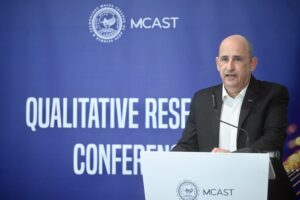 Opening the conference, MCAST Principal and CEO Mr Stephen Vella set out the case for qualitative inquiry as a necessary complement to the quantitative measures that institutions typically rely on to assess their own performance.
“We can measure student enrolment, course completion and employment outcomes. But these figures cannot fully explain why a student struggles, what gives someone the confidence to return to education, or how a particular learning environment affects a person’s experience. To understand these realities, we need to listen, ask questions and sometimes challenge our own assumptions. This is why qualitative research matters.” — Mr Stephen Vella, Principal and CEO, MCAST
The conference drew three internationally recognised keynote speakers: Professor Nicole Brown of University College London, Dr Sawsan Malik of the Arab Open University in Kuwait, and Dr Scott Kupferman of the University of Colorado in the United States. Their addresses offered complementary perspectives on methodological development, technological change and the application of qualitative approaches across disciplines and institutional contexts.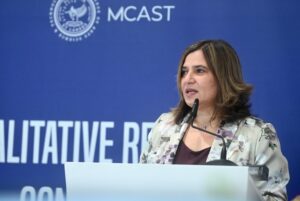 Across the first two days of the conference, 28 research presentations were delivered, organised into four thematic tracks that reflected the range of methodological approaches and disciplinary contexts represented among presenters: Transformative Practices and Creative Approaches in Qualitative Research; Communities, Inclusion, and Social Change through Qualitative Inquiry; Leadership, Organisations, and Human Experiences in a Changing World; and Applied Qualitative Research Across Disciplines.
Each research session was followed by a panel discussion, in keeping with the conference’s emphasis on academic dialogue and critical reflection rather than presentation alone. Mr Vella underscored this in his opening remarks, noting that a conference’s value lies as much in the conversations it generates as in the papers it hears.
“Some of the most useful ideas emerge from conversations outside our immediate areas of expertise. I encourage everyone to participate actively, ask questions and engage with researchers working in different disciplines.” — Mr Stephen Vella, Principal and CEO, MCAST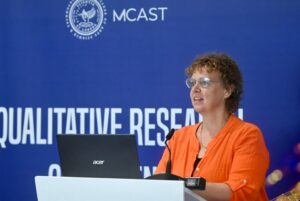 The third day of the conference was dedicated to a Doctoral Colloquium, providing doctoral students and early-career researchers with a structured forum for questions, feedback and academic exchange. Mr Vella described support for emerging researchers as a collective institutional responsibility, and one that MCAST intends to take seriously as it develops its research culture.
“Supporting emerging researchers is a collective responsibility for MCAST. We are committed to encouraging our lecturers and professionals to pursue research, strengthen their expertise, and contribute knowledge that serves the common good.” — Mr Stephen Vella, Principal and CEO, MCAST The 2026 conference took place at a strategically significant moment for MCAST. As the College marks its 25th anniversary, its recently launched Vision Towards 2030 and Artificial Intelligence Strategy set out ambitions that place research—and particularly its application to real institutional and social challenges—at the centre of MCAST’s future direction.
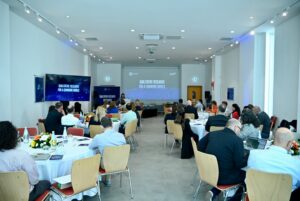 The Qualitative Research Conference has become an established part of MCAST’s annual research calendar, alongside the Research and Innovation EXPO and the College’s inaugural Research Awards, held earlier in the same period. Together, these events signal the growing maturity and visibility of research as a core dimension of the institution’s identity.



 MCAST Main Campus
 +356 2398 7100
 information@mcast.edu.mt