
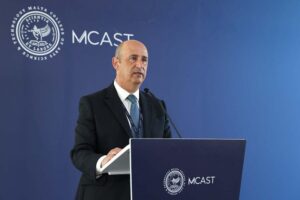
By Stephen Vella, MCAST Principal and CEO
Recent comments made during a radio programme by the Rector of the University of Malta, Prof Alfred Vella, regarding the financial deficit currently faced by the University require clarification, particularly about the role and development of the Malta College of Arts, Science and Technology (MCAST).
A healthy debate about the future of education in Malta is both necessary and welcome. However, such debate must be grounded in facts and framed within the broader national interest. It is therefore surprising that statements are made that the financial challenges currently faced by the University of Malta appear to be directly or indirectly linked to the development of MCAST.
Suggesting that the growth of vocational and applied education is somehow responsible for the University’s difficulties is not only inaccurate but also risks diverting attention from the real issues that must be addressed.
Over the past 25 years, MCAST has become one of the central pillars of Malta’s education and training ecosystem. Since its establishment in 2001, the College has graduated tens of thousands of students across the Malta Qualifications Framework, from foundation programmes and apprenticeships at MQF Levels 1 and 2, through diplomas and advanced diplomas, to Bachelor’s and Master’s degrees at MQF Levels 6 and 7.
Every year, thousands of MCAST graduates enter Malta’s workforce with the technical, practical and professional skills that industry requires. Increasingly, MCAST is becoming the first choice for students seeking vocational and applied education, particularly those who want a clear pathway to meaningful employment.
This achievement is not accidental. It reflects a deliberate national effort to strengthen vocational and applied education, an area that for decades was underestimated despite its critical importance to Malta’s economic development.
MCAST programmes are designed in close collaboration with industry, and our model emphasises work-based learning, apprenticeships and employer partnerships. As a result, students graduate with both knowledge and experience, allowing them to contribute immediately to Malta’s economy.
Vocational education should not be reduced to a pathway to employment, but institutions like MCAST are about far more than preparing people for jobs. Through applied research and hands-on learning, the college nurtures curiosity, builds confidence, and helps individuals discover their potential while contributing meaningfully to their personal and professional growth.
The growth of MCAST is not the problem some portray it to be. It is, in fact, a necessary response to the evolving needs of a modern economy.
Malta requires skilled professionals in engineering, digital technologies, maritime industries, healthcare, aviation, creative sectors and advanced manufacturing. These sectors demand a blend of academic knowledge and practical competence. Applied education and vocational training are therefore essential if Malta is to remain competitive.
It is therefore misleading to suggest that MCAST is attempting to “mimic” the University of Malta.
MCAST has developed as a distinct and complementary institution, offering applied pathways that sit comfortably within the Malta Qualifications Framework and align with the European Qualifications Framework. Our role is not to replicate academic institutions but to provide practice-oriented education that bridges the gap between education and industry.
Education in Malta should never be framed as a contest between institutions.
Both the University of Malta and MCAST serve important and different national functions. The University contributes through research, academic scholarship and professional programmes. MCAST contributes through applied learning, vocational excellence and strong engagement with industry.
These roles are complementary, not competing.
If anything, Malta’s education system benefits from offering multiple pathways that allow students to progress according to their abilities, interests and aspirations. Many students thrive in academic environments, while others excel in technical and applied fields. Both pathways are equally valuable for the country.
The success of MCAST over the past quarter-century clearly demonstrates that vocational education can be innovative, respected, and impactful. It has opened doors for thousands of Maltese students who might otherwise have struggled to find a pathway aligned with their strengths.
More importantly, it has helped Malta develop the skilled workforce that our economy increasingly depends upon.
The real challenge facing Malta’s education sector is not the existence of different institutions. The real challenge is ensuring that Maltese students are offered programmes that respond to industry needs, technological change and future economic realities.
If anything, Malta should be expanding vocational and applied education, not questioning its existence or importance.
Constructive dialogue between institutions is always welcome. However, it must be based on mutual respect and a clear understanding that the success of one part of the education system strengthens the whole.
At MCAST, we remain fully committed to our mission: developing talent, supporting industry and contributing to Malta’s national development. Our focus remains firmly on our students, their aspirations and the opportunities we can create for them in a rapidly changing world.
Malta’s future will not be built by diminishing vocational education. It will be built by strengthening it.



 MCAST Main Campus
  +356 2398 7100
 information@mcast.edu.mt